

Monarchs make their annual migration as a result of integrating environmental cues with genetically-encoded programs. We leverage next-generation sequencing and novel molecular tools in naturalistic field settings and controlled environmental chambers to elucidate these cues and programs.
You can read more about some of this work: University of Michigan News, Popular Science, the Wildlife Society, and Earthsky.
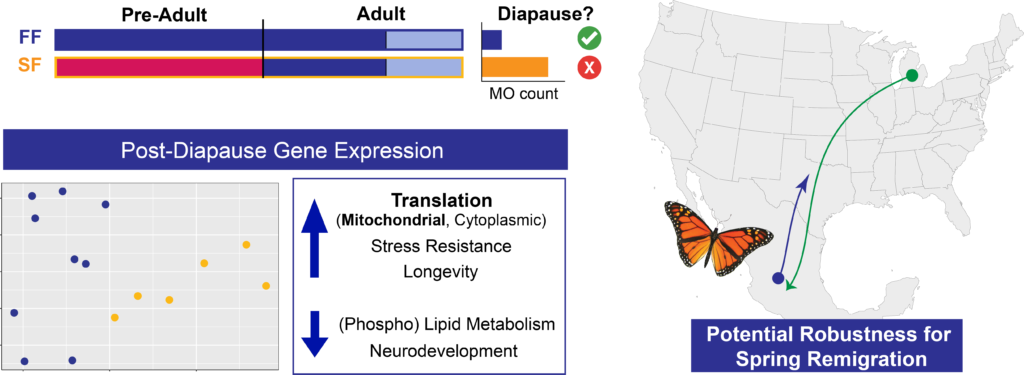
Sam found that monarchs that underwent diapause actually experience effects long after returning to permissive conditions and standard development (particularly, their brain gene expression is different). These monarchs retain some features that are diapause-like, but do so through different genetic mechanisms. This history of diapause may contribute to monarchs’ surprising robustness for their spring remigration. Read more about it here!
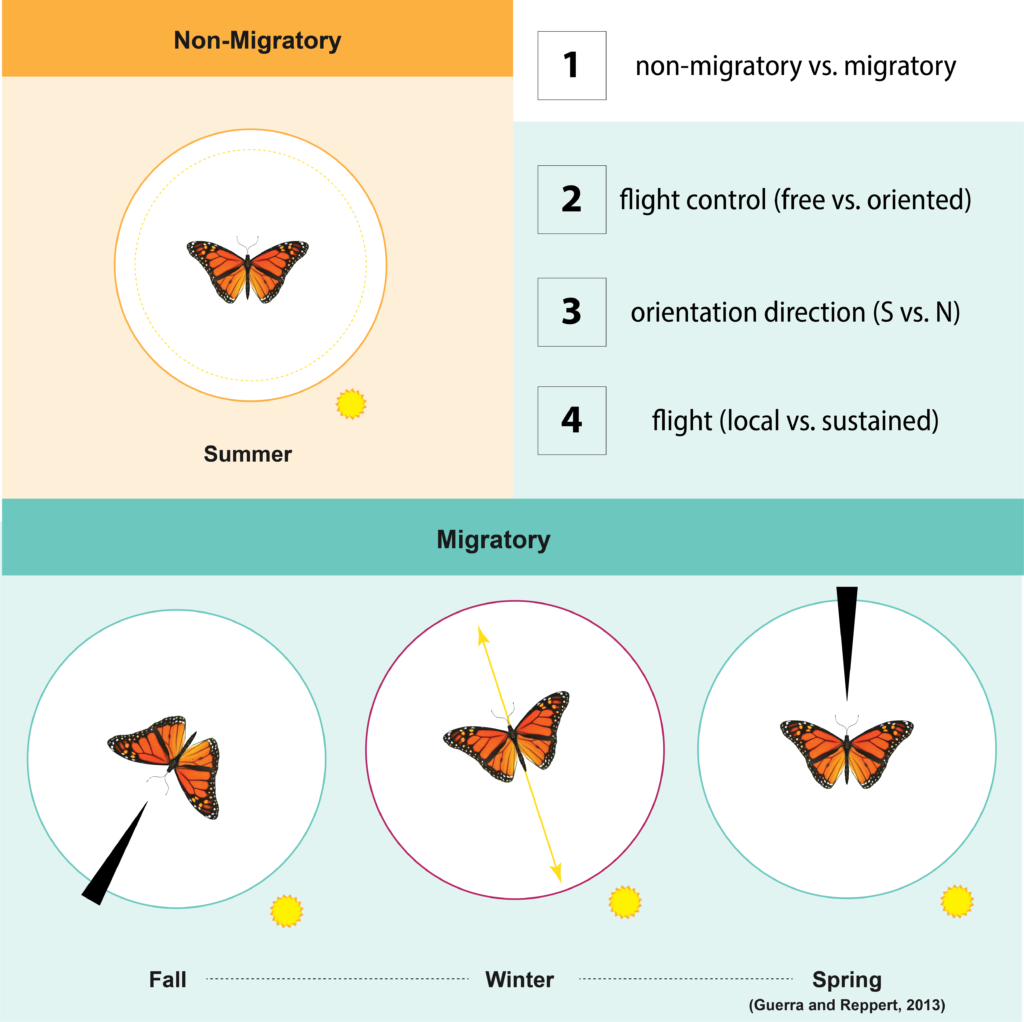
Monarchs are one of only two known insect species where individuals make bi-directional migrations (i.e., an individual butterfly flies both southward and northward). Guerra and Reppert made the remarkable discovery that cold temperature was the critical cue to make monarchs switch from southward to northward flight heading. We followed up on this work to understand how monarchs’ behavior changes once they reach the overwintering sites by testing their behavior in a flight similar (for the first time) at the Mexican wintering sites. Monarchs turn off their southward heading and turn on a daily heading that depends on the time of day (this matches “streaming” behaviors observed of monarchs at the overwintering forests). This finding shows that monarchs’ “migratory” state is highly dynamic, akin to those of vertebrate migrators (e.g., birds, fish, etc.). You can read more here!
Recent Publications
- Stratton SM and Green II DA. Diapause history has lasting effects on adult brain gene expression in monarch butterflies (2025). Journal of Insect Physiology, 104893. https://doi.org/10.1016/j.jinsphys.2025.104893
- Green II DA, Polidori S, and Stratton S. Modular switches control a shift in monarch butterfly migratory flight behavior at their Mexican overwintering sites (2024). iScience 27(3): e109063. https://doi.org/10.1016/j.isci.2024.109063.
- Green II DA* and Kronforst MR (2019). “Monarch butterflies use an environmentally sensitive, internal timer to control overwintering dynamics.” Molecular Ecology. https://doi.org/10.1111/mec.15178. (* indicates corresponding author)